Thanksgiving and Malediction
What’s the opposite of “thanksgiving”? If not giving thanks, what are you doing? Not just failing to give thanks, ingratitude as opposed to gratitude, but the opposite–isn’t that a malediction, a curse? Having sifted through hundreds of anecdotes and accounts, as well as her own experience, the Anthropologist has concluded that on the fourth Thursday of November people in the twentieth- and twenty-first-century U.S. celebrated either Thanksgiving Day or Malediction Day. Some celebrated a Thanksgiving portrayed by Norman Rockwell: cheerful family gatherings, Macy’s Parade and football on the television, sales at the big-box stores. Others marked an annual day of resentment and confrontations, anger and boredom. Every family creates traditions.
Traditions for Dani, Deenie, and Gma included, besides a turkey baked brown and dry: the hand-crocheted tablecloth done by Gma and her sisters when they were young; orange juice with a scoop of lime sherbet as some kind of appetizer; cranberry sauce jellied in a tin can, pushed out onto a plate with a birthday candle poked down and lit for a centerpiece; and Dani’s childhood Nelly Doll propped up on a chair at the end of the table.
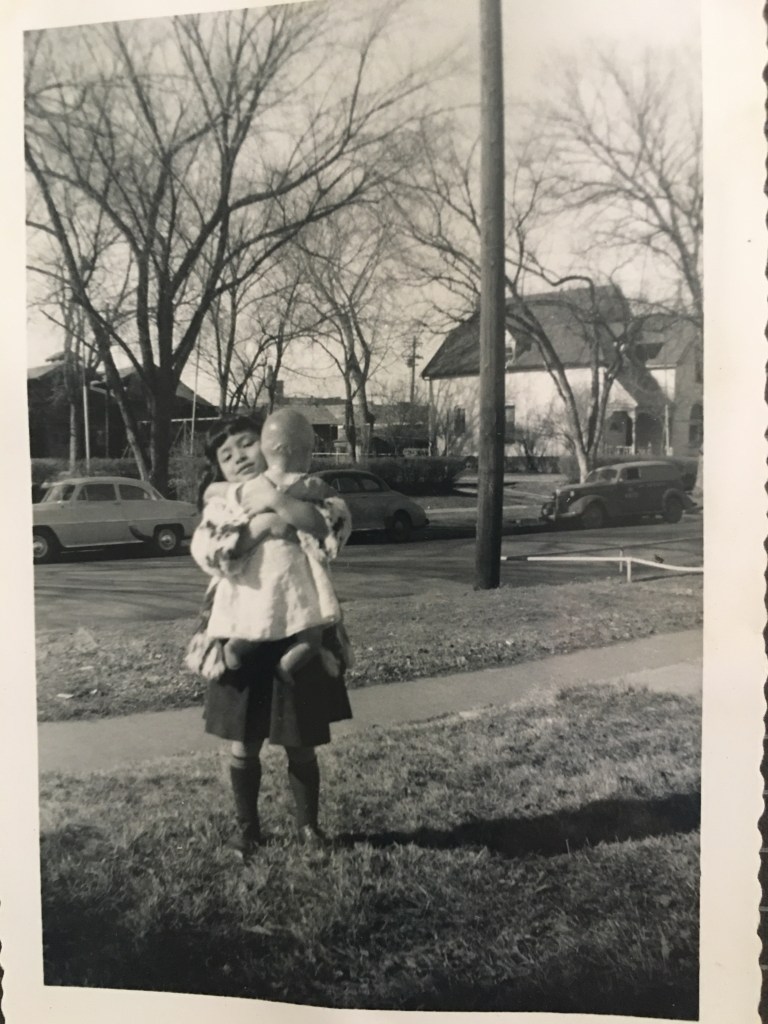
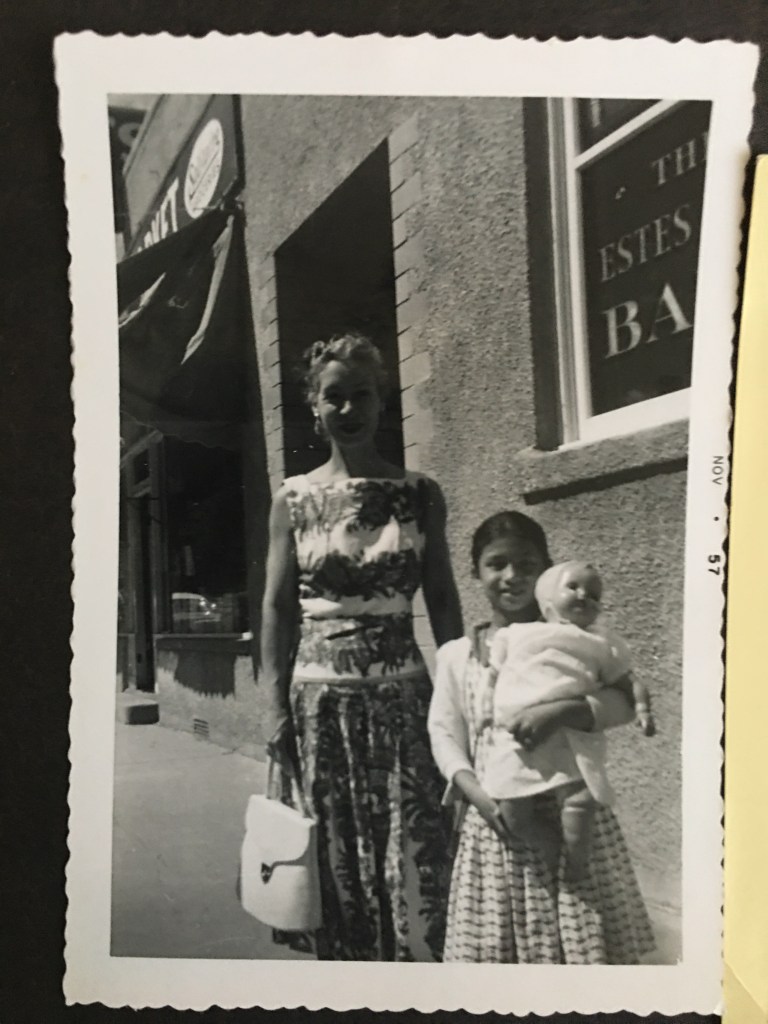
Nelly Trythall, a public school teacher and good friend of Gma, had given toddler Dani a huge baby doll we named “Nelly Doll,” as if it were always necessary to distinguish her from the adult. She had a plaster, not plastic, head sewn to a body stuffed with wool so that she weighed as much as a human infant. Next to me in bed, she was like a weighted blanket. Nelly Doll was a younger sibling in my early years so that I didn’t have to be an only child. As I outgrew my clothes, they went to Nelly Doll. Gma and Mama made little caps and bibs for her. She went with Dani to Pittsburgh. We continued to honor Nelly Doll as I grew older by reserving a place for her at the holiday table.
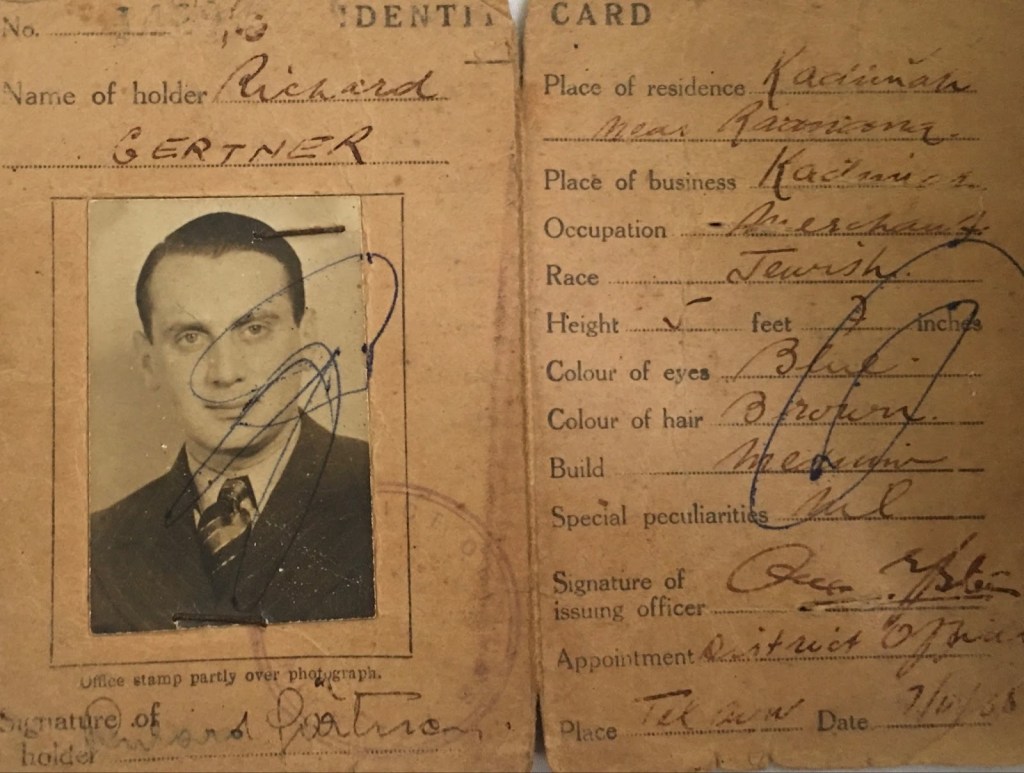
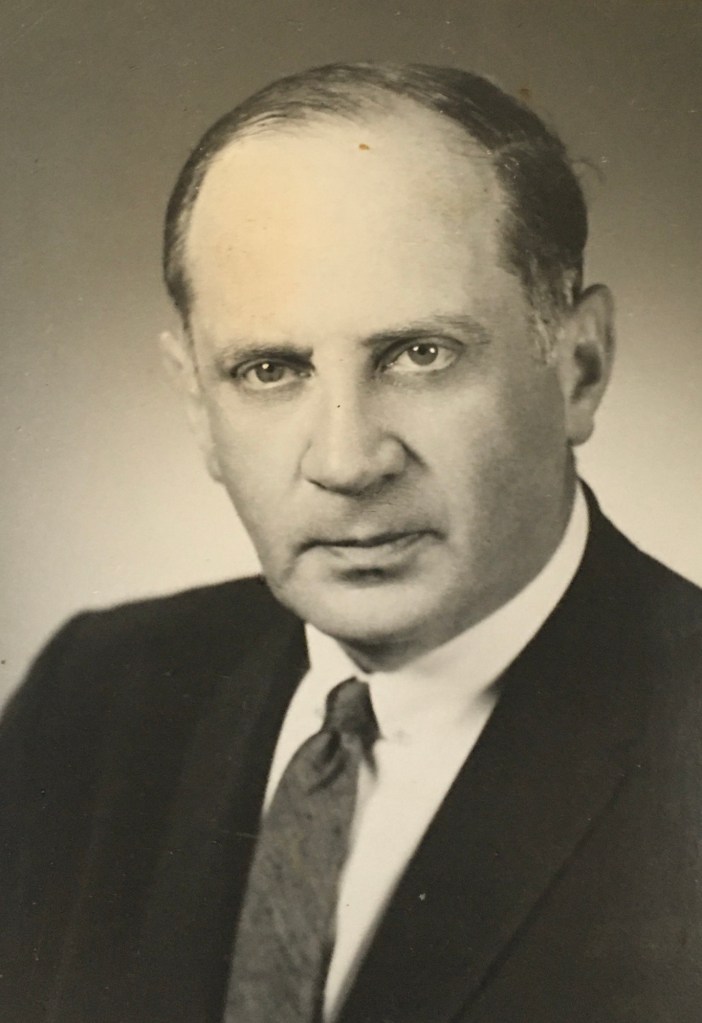
Richard put an end to those traditions. Mama brought Richard home to introduce him at the holiday dinner when I was in fourth grade. Deenie, working as a waitress, first met Richard as a customer. Pictures of him as a younger man are striking for the brooding eyes and sensual lips. By the time I met him, he was portly and balding, skin beneath his eyes pouched and his mouth a pout. Mama was enchanted by his mind, she said, his experience of the world. Richard had grown up in Austria as the son of a rabbi, been a British major in World War II, and fought to make Palestine Israel. “However did he end up in Denver?” I always wondered. He was Gma’s age, old enough to be Deenie’s father. Maybe that’s why she became so devoted to him. He had a deep voice and European accent, could discuss any topic. Or to be more precise: Richard could dispute any topic. He loved to argue and antagonize.
The Beginning
And how he enjoyed antagonizing us that day! The sherbert was faux sophistication from a ladies magazine; the cranberry candle was kitsch. “How old are you?” he asked me. When I answered, he exclaimed, “You’re too old to be playing with dolls!” He ridiculed Nelly Doll in her traditional place, her painted plaster baldness. And so began our annual celebration of Malediction Day.
Richard had a beautiful voice and acted in community theater groups. Perhaps if I had first seen him starring in Fiddler on the Roof, which he did years later, we would have done better. However, the first play I saw Richard perform was Gaslight in which he played the villainous husband. Our term “gaslighting” comes from that play. Merriam-Webster defines it as “psychological manipulation of a person usually over an extended period of time that causes the victim to question the validity of their own thoughts, perception of reality, or memories and typically leads to confusion, loss of confidence and self-esteem, uncertainty of one’s emotional or mental stability, and a dependency on the perpetrator.” Richard was brilliant in that role, every bit as smooth and sinister as Charles Boyer in the 1944 movie.
So Mama married him. Life does, in fact, imitate art. Sometime I’ll describe how it ended up that Mama did go insane with Richard in attendance while I stayed with Gma. Although I chose to live with Gma, I stayed weekends with Mama and Richard for the few years they lived in Denver, and spent summers once they moved to Washington, D.C. I usually went to them for Thanksgiving and Passover. That was plenty of time for many, lengthy disputations. It seemed to me that Richard never stopped playing his Gaslight role.
A typical exchange: once Richard came home very late without explanation, and I said something normal like, “We were so worried!” He sneered that such worry was merely reaction formation (per Anna Freud), that in fact I had been subconsciously hoping for an accident. “You are not willing to admit how much you despise me, so you convert your hopes for my demise into these sentimental expressions of concern for my well-being.” I don’t think that was true; my subconscious swam fairly close to the surface. When Dani had wished George deep in Lake Gunnison, she knew what she wanted without any need to mask or distort her hope. No, I was just worried that Richard had been in an accident and Mama would fall apart.
What a great opportunity I missed to volley his accusation to score that day! If Mama or I were late by even 20 minutes, Richard always set in motion his protocol of calling hospitals and the police to check on us. I should have pointed out to Richard that such calls must have represented a great deal of anger rather than worry. Isn’t this the way with a family fight? Here I am, sixty years after the original dispute, still coming up with retorts to a man who has been dead four decades.
I was too religious, too prudish, and would end up frigid, according to Richard. Once I walked into the bedroom when Mama was changing. I apologized and started to back out quickly. “No!” Richard commanded. Why should I be embarrassed seeing my mother naked, or anyone nude? He required me to stay and watch, red-faced, as my mother dressed.
At this point I intended to complain that he dragged Mama and me to see art films like I am Curious (Yellow). My memory is that I was far too young for the film and that the main scenes were hideously erotic. Yet, when I look the film up on Wikipedia, it seems I was probably 19 when we saw it, and that it actually involved a young girl passionate for social justice with a father who had fought fascists. And that suggests Richard was doing more than trying to make me uncomfortable watching Swedish nudity; there was some other intended lesson. I grudgingly admit our relationship was more complex than simply adversarial.
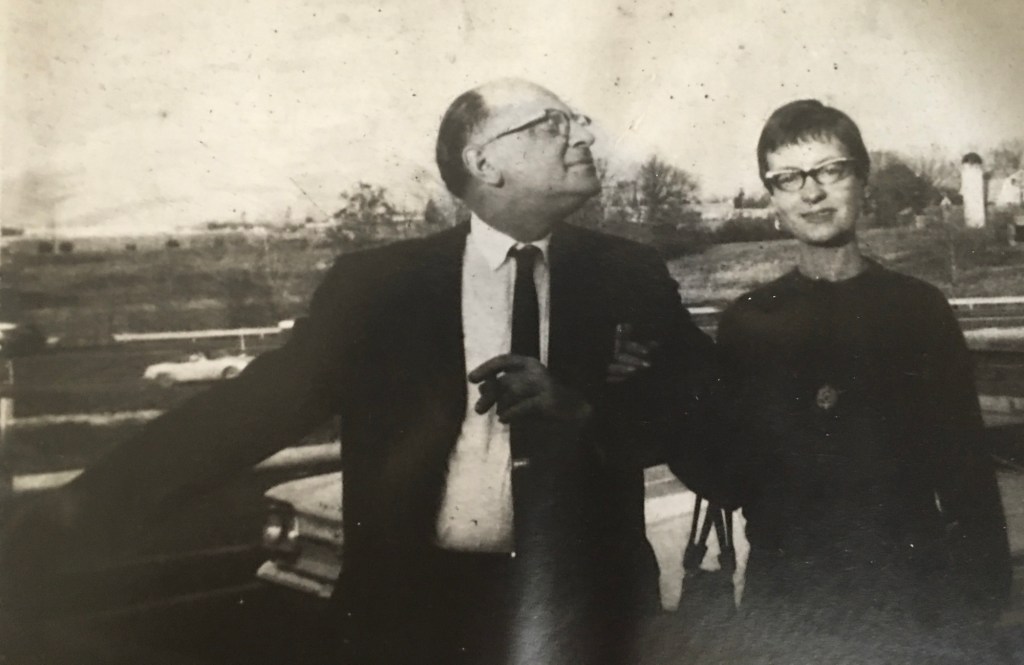
Mama once confided in me the greatest lesson of her life with Richard. And this was a true gift of wisdom. “I thought that I could make Richard happy. You can never create happiness or healing for a depressed person.” Yes, that is perhaps my mother’s most significant legacy. I should have it gold-embossed if I ever print this out, or at least put it in a bold and colored font:
You can never create happiness or healing for a depressed person.
Richard, like every European Jew from the twentieth century (or any century Anno Domini, for that matter) had good reason for his depression. In 1935 he had recognized the threat Hitler posed and urged his family and friends to leave Austria. His father and brother listened and left. The father ended up as a rabbi in Brooklyn; his brother became a Communist in Canada before committing suicide. Richard’s sister Regina, a student of Jung, escaped later. Even though you can find a prolonged debate about the extent and pragmatism of Jung’s collaboration with the Nazi regime or whether his archytype ideas fed/fit anti-Semitism, Jung did help some of his Jewish students escape, so Regina survived. Richard’s mother and another sister, though, waited too long and died in the concentration camps. Judging from Richard’s experience, it is a misnomer to call anyone a “holocaust survivor.” No one, even those who evaded or escaped the camps, really survived the Nazi experience.
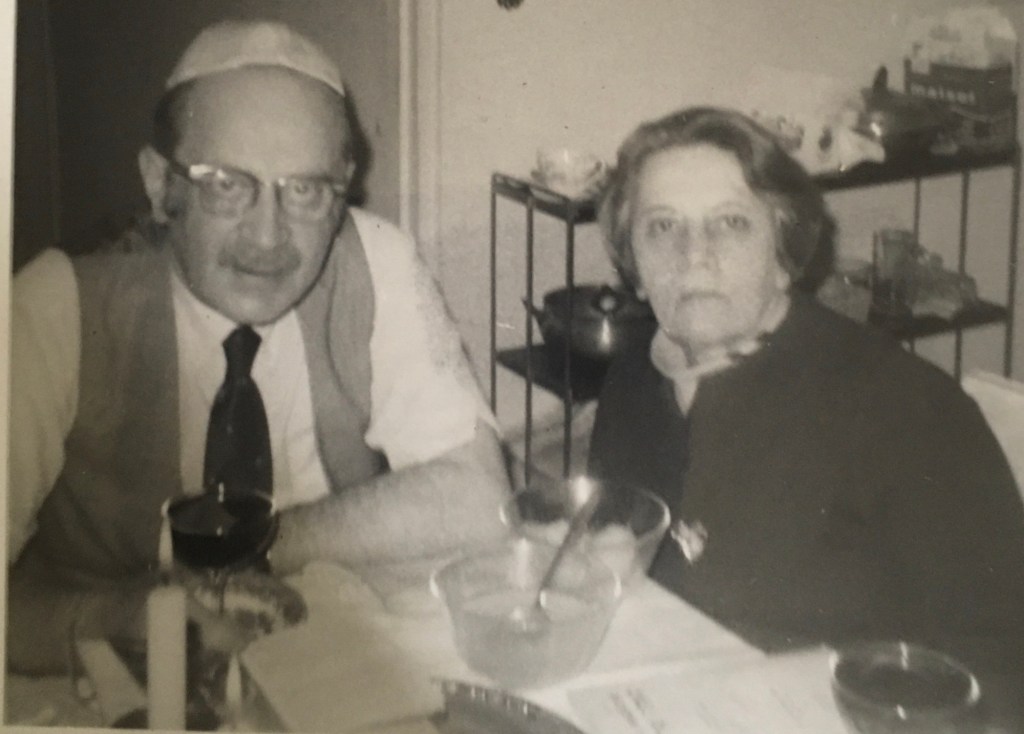
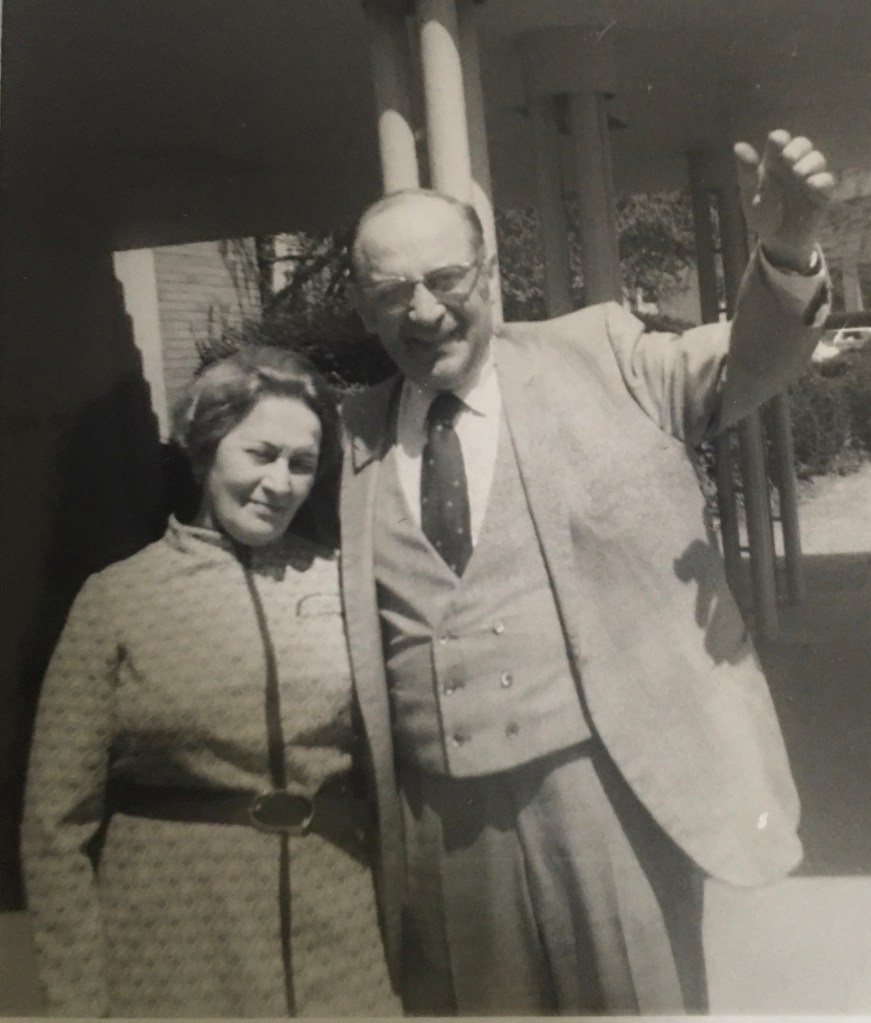
Was this depression? We speak of depression as a pathology, some kind of illness from which we should recover. But wasn’t Richard’s never-ending grief and rage an appropriate human response to what his generation endured? [ Isn’t mine? ] He was wrong to exercise those feelings on a child or the Palestinian people, but that doesn’t mean his feelings about the collapse of humanity were a disease.
When I am in a conciliatory mood I even speculate that Richard puzzled over this question too. I confronted him once, “You’re saying that anyone who is not miserable is not genuinely moral or human!” Richard softened. He replied sadly that he should have exposed me to other strains of Judaism that believed in joy, told me bits about the Lubavitchers, and gave me a story about the Ba’al Shem Tov to read. And when I look over the photos there is an occasional one of him appearing to enjoy himself.
Richard followed politics closely and always with an eye for the coming catastrophe. When Barry Goldwater won the GOP nomination in 1964, Richard got passports for Mama and himself, ready to repeat his flight from fascism. I note that he didn’t get me a passport.
Mama converted to Judaism, going whole hog (if you can forgive a pun in very poor taste) into the conservative version. For those keeping score, this was Strike Three for Gma before God: One–The Divorce, Two–Joey’s Conversion, and now Three–Mama’s Apostasy. Mama kept a strictly kosher kitchen with multiple sets of dishes and had an extensive collection of cantorial recordings. She studied Hebrew and recited prayers with a Pittsburgh (drawled /æ/) accent that sounded dreadful. Shabbat dinners and Sedars were formal and beautiful, set out on the crocheted tablecloth. Nonetheless, Richard and Mama decided it would be confusing and destabilizing to move Dani from Emmaus Lutheran or challenge her religion. So I continued as Giesela Marie and consequently was held personally accountable for the Holocaust.
Ours was a family that never would consider buying a VW or Ford because of the cars’ Nazi lineage. I recall a discussion of Safeway’s possible murky ties. The music of J.S. Bach was the only redeemable feature of Lutheranism. When I tried to explain that a professor I liked, a German refugee, had personally opposed Hitler, Richard sneered that he had never met a post-war German who didn’t make that claim.
I suspect this is why I cannot read or speak German. At Emmaus we began studying the language in fifth grade, so I had four years there, plus two in high school and another two in college. Yes, German does have a complex syntax. Even so, it seems peculiar that after eight years of study I could earn a B in class but not speak a complete sentence. In college I chalked this up to the surrealistic nature of our readings. The fairy tale that ended with the heartbroken girl sitting under the tree with her love and blood draining into the soil to bloom in the spring as roses–of course that took a lot of cross-checking in the dictionary to be sure that was really the point. Or the short story in which the guy goes into the bar and says, “Ich möchte, dass mein Bier erhitzt wird.” That translates into “I’d like my beer heated,” which reads as nonsense to an 18-year-old. And for the rest of that story the guy sips warm beer and turns over a red card, then a black card, then a red card…. Who can learn to speak German based on that? I did love the harsh consonants and rhythm of German, though. I recall thinking how well the word “Die Kreuzigung” captured the piercing sorrow of Good Friday better than “crucifixion.” I realize now that it was verboten to really learn German. Richard mocked my inability to master German when he himself spoke five languages, but if I had ever dared to utter the language of Wagner and the Nazis, it would have been the final, damning evidence of Giesela Marie’s complicity with the German Holocaust.
To be honest, however, Richard became a keystone in the span of my years. Love of classical music? From Richard taking us to concerts at Rock Creek Park every summer and his radio playing classical music as our constant soundtrack. Appetite for dill and herbs? From Richard taking us so often to European and Middle Eastern restaurants, not to mention all those Jewish delis. Pretentious intellectualism? From Richard baiting me to read so much Freud and Eric Hoffer. A conviction that our first duty is to the barricades defending humanity from barbarism? From Richard, who regarded accounts of the Warsaw Ghetto as appropriate bedtime reading. Giesela Marie learned loyalty to the oppressed from Hannah, Mary, and the Apostle James, but maybe I veered toward those sections of the Bible because they were more compatible with Richard’s world view than those snide remarks about Jews in the Epistles.
So this leads to that final Malediction Day.
The Ending
“It was my thirtieth year to heaven…” Somehow this feels like it should start out with something as lyrical and profound as Dylan Thomas words. I was headed to Washington, D.C. for the annual Thanksgiving aka Malediction gathering, this year with even my Gma attending, a first in decades, for a reconciliation of sorts.
Richard had struggled for years to find suitable employment. In the early 1970s he had left his job as a fundraiser for United Jewish Appeal to go into business with Joel Kline, who turned out to be laundering shady money for Maryland politicians as a crony of Spiro Agnew. Klein made a deal and spent only four months in prison in exchange for testimony. Richard avoided prosecution because he could produce a letter he had written to Kline questioning some curious bookkeeping, evidence of his ignorance and innocence of wrong-doing. Without Kline’s backing, though, Richard couldn’t make his business work. I spent one horrible weekend helping conduct the bankruptcy sale of everything in a huge carpet warehouse because both Richard and Mama went into the hospital for the occasion. There followed years of miserable job hunting until Richard decided to train as a legal paraprofessional. He had completed the course and that fall was interviewing with law firms, a man in his sixties competing with throngs of young, eager applicants.
He was on the phone with Mama, enthusiastic about the day’s interview that had gone so well. “I’ve never been so happy!” he told her, and collapsed to the floor. Gma, intent on the reconciliation, went over and tapped his shoulder. “Are you all right, dear?” she asked. Then she picked up the phone receiver and told Mama he wasn’t responding. Mama rushed home as Gma called 911.
Fortunately, when the paramedics asked whether Richard had served in the military, Gma automatically answered, “Of course–World War II!” without mentioning it was British service. This turned out to be important because the apartment was exactly on the boundary line between the District of Columbia and Crystal Springs, Maryland. Gma’s answer determined whether Richard would be taken to Walter Reed Military Hospital in D.C. or a Catholic hospital in Maryland.
I had to join Mama at Richard’s bedside at Walter Reed, watching the heavy equipment at work on his body and listening to the doctor explain that he was, in fact, brain dead from a massive stroke. If Gma had not answered correctly, Richard’s body might even now be pumping on respirators in Maryland. Instead, we began the torturous process required to determine whether to turn off the machines.
We had to go through five rounds of interviews with doctors and social workers before Mama could sign her agreement to turn off life support. I’ve always felt that this was excellent training; after the experience I usually succeeded in getting any job I actually wanted if it involved some face-to-face interview. One had to respond with pitch-perfect sincerity, focusing intently on what the interviewer wanted to hear: if we expressed any doubt or hesitation about turning off the equipment, they would deny the application. On the other hand, if we sounded too eager to be done with it, they would deny the application. Maintaining composure through the same questions, over and over again, was hard but seemed to mean everything. By round four I was struggling not to scream at the bland face of bureaucracy across the table, not to giggle hysterically. But eventually we managed to run the gauntlet successfully.
I said, “Goodbye, Richard” out loud at his bedside. Mama kissed him. Then we waited down the hallway until the nurse brought Mama his wedding ring a short time later.
In accordance with Jewish traditions, Richard was buried as soon as possible. I remember pinning on the black scrap of cloth with some hesitation, thinking that it would have been more suited to Richard’s style for us to genuinely rend and rip our clothes. I knew Richard would not approve of such a token ritual; he would be denouncing the mere scrap of black cotton as evidence of a deep-seated lack of feeling for him. We should have been sitting on ash heaps instead of pews. It had been more than a decade since my college year studying Hebrew; I had lost it all. Except during that service I could read and understand Hebrew fluently.
After the service there was a meal with those who claimed to be Richard’s friends, one of whom was genuine and had guided me through the bankruptcy ordeal, and all the others who had turned their backs on Richard during his desperate years of disgrace and unemployment. I maintained silence and did not denounce them as the shallow, fickle supporting cast of Job’s friends that they were. I wasn’t sure what Richard would have me say.
The cemetery was on a fairly gentle hillside. I made a silent agreement with Richard not to come and dance on his grave as a younger Dani had threatened. As we moved off, Gma tripped. “I’m okay,” she insisted as we helped her to the car. I suspect that Gma felt it was her fault that Richard had died. Perhaps she blamed herself for not immediately hanging up on Mama to call 911 when Richard fell; would the ninety seconds have made a difference? More likely, Gma feared her many years of blaming Richard for corrupting her Deenie had caused his stroke. Gma’s guilt was Lutheran and ran deep, so she kept silent about how much the fall hurt. It was only hours later when we heard her whimpering in the middle of the night and pulled back the bed covers to see her leg swollen three times its normal size that we realized Gma had broken her leg. We took her to the nearby Maryland hospital emergency room.
Tante Gina came for Richard’s funeral and the following days of mourning. I remember we were sitting shiva – in reality, I was lying down on the heavy brocade couch, numb – when Tante Gina held a plate heaped with waxy yellow chicken fat up to my face. “See, Liebchen, I’m making schmalz; I’ll cook you something good.” I stumbled to my feet and went to the bathroom to throw up and cry. But when I came out Tante Gina gave me the best kasha varnischkes, which taste right only when cooked with schmalz, not olive oil, as I have learned through trial and error. Tante Gina – of her I can wholeheartedly say, may her memory be a blessing.
The Final Word
And still Richard demanded the final word. Mama fell apart for some time, so I had to deal with his personal effects. I found some place that would give away rather than sell his clothes. I sorted and disposed of his papers. Foolishly, I read some of his journal entries and short stories.
One story seemed to be non-fiction. In it Richard described a young man violating his sister. Perhaps he was trying to describe what Mama had told him about her experience with Joey, I hoped. That would be “putting the best construction on everything,” as the Lutheran Catechism has always enjoined me to do. But the setting sounded more like he was describing his own experience or fantasy; the dialogue sounded too familiar. I was chilled to read the boy taunt the girl that she was too prudish. Richard had never pushed the issue so far as the story’s character to make me prove myself, but had that been the undercurrent? If the story was true, that might explain Richard’s agonizing guilt following his sister’s death in the camps. Or did he feel guilty? Perhaps he was just recording it as a memoir since, as The Anthropologist has reminded us, in those days boys would be boys.
The other journal entry was far more painful; I can only describe it now because poor Deenie is gone and cannot hear this. In it Richard wrote coldly that Mama, despite her sincere conversion, remained only a shiksa to him. Reading that, I wanted to break my promise and go dance – no, piss – on his grave. Deenie gave up her daughter for him, endured his gaslighting for decades, supported them by working twelve-hour days – and yet she was not worthy to be one of the Chosen People. Had he never read the Book of Ruth about that righteous convert? Probably not, since it is not the Torah. A part of my mind attempted excuses: perhaps he only meant to say she remained the desirable, forbidden woman in his life or he wrote it when she had upset him. But there it was.
So I burned it.
And say, Amen
Sometimes I long to chant Kaddish for Richard. I would bask in his spluttering rage, chanting it as the obnoxious unJewish undaughter, unworthy to perform such a mitzvah. How he would writhe, knowing I would chant “Israel” referring, not to the nation state he championed, but to all of us as the descendents of Jacob who wrestled with the angel.
Glorified and sanctified be God’s great name throughout the world
Which he has created according to his will. . . .
Blessed and praised and glorified and exalted, extolled and honored,
adored and lauded be the name of the Holy One, blessed be He,
beyond all the blessings and hymns, praises and consolations that
are ever spoken in the world; and say, Amen.
May there be abundant peace from heaven, and life, for us
and for all of Jacob’s children; and say, Amen. . . .
All of which is to say that even in the midst of a malediction and a cursed life there can yet be thanksgiving.
But then the whirlwind shifts and I hear a different voice, Job of the latest translation*, who refuses to submit to such comforting and hopeful praise, who is left with only pity:
Up spoke Job to YHWH and he said:
I have known you are able to do all
That you cannot be blocked from any scheme. . . .
Truly I’ve spoken without comprehending–
Wonders beyond me that I do not know. . . .
As a hearing by the ear I have heard you
And now my eye has seen you.
That is why I am fed up;
I take pity on “dust and ashes.”
Job 42:1-6 translated by Edward L. Greenstein
Thanksgiving and hope or disgust and pity – which is the more appropriate response for an Anthropologist?
*Greenstein’s translation challenges the tradition of having Job finally recant his questioning and repent before God’s infinite power and wisdom. Greenstein makes a detailed case for translating the Hebrew as “That is why I am fed up” instead of “I despise myself and repent.”
Return to Song of Samuel index
Continue to Mother Love and the Minotaur

