48–Water over Wood: Jing Source
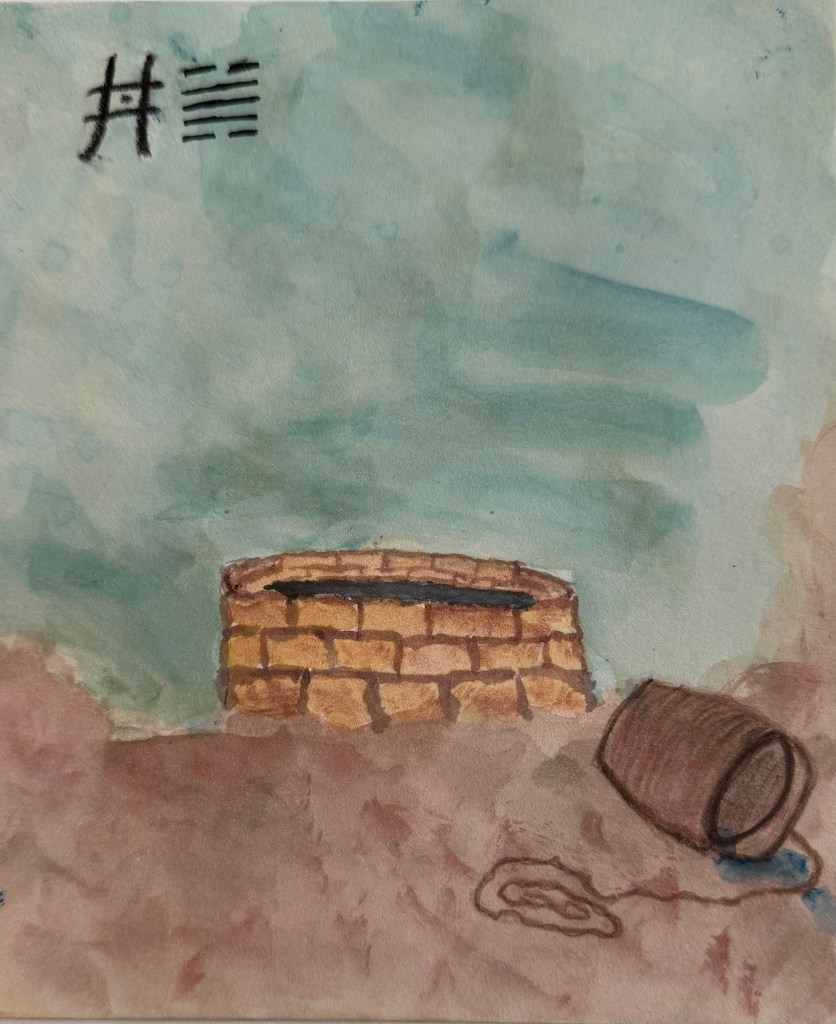
Names for this Gua:
Translation by Wing: The Source
Translation by Huang: Replenishing
Translation by Pearson: The Well
The Decision in various translations:
Wing: “The Source. The location may change, but not the Source; nor is it ever exhausted. Again and again one can tap the Source. But if the connection is not quite made or the vessel is weak, there will be misfortune.”
Huang: Replenishing. “The site of the village may be moved, not the well. Neither loses nor gains. Coming and going, drawing, drawing. Nearly out of the well, Break one’s bucket–misfortune.”
Pearson: “The Well. Move the city, but do not move the well. But if it dries up, the rope is not there yet, or the bucket is damaged, misfortune.”
Commentary on the Image
Pearson: “Above wood, there is water: the image of the well. You should reward others and all should encourage each other.”
The Yao text
The Yao text describes various stages of a well: so old and muddy that even birds don’t use; tiny fish at the bottom; dredged; well tiled on the side; pure and icy; uncovered for all to use.
Pearson explains: “The spring that furnishes water for a well is inexhaustible, but the human apparatus to reach the water is not…. Instead of neglecting the reliable sources of our sustenance, whether they are water, shelter or relationships, we need to remember to maintain them before they are broken….Individuals also what sustains them, both bodily and emotionally to maintain these lifelines even if they seem humble and unimportant.”
Huang notes the sequence and comments, “After becoming exhausted one needs replenishing…. the well is the symbol of being replenished.” He suggests the ideograph is actually of the ancient Jing land system. Nine land parcels were distributed to eight families who shared the well and cultivated the center for the government in Zhou times.
A personal reflection
Ours is a time of when we desperately need to think about ecosocialism. There is so much to consider about the natural resources and our human means of using them. Our frayed ropes and leaking buckets are inadequate for using the natural resources that, after all, are not inexhaustible. We need to move the city, not the well–change our ways, since the resources are fixed.
Huang’s description of the ancient land system reinforces Pearson’s translation of the Image: “You should reward others and all encourage each other.” There is a connection between the themes of human cooperation and human uses of natural resources. Our civic abuses fit our abuse of nature.
Another thought: “replenishing” in our society too easily slides into “consuming,” only because we don’t reflect deeply on what we need to replenish.
Of course, with my background I can’t read this without thinking of the incident in John 4, Jesus with the Samaritan woman at Jacob’s Well. How common in cultures to have the well as the meeting place and as a metaphor for our source! The incident at Jacob’s Well is weighted with messages about overcoming ethnic divisions and personal pollutions, about seeking a spiritual source.
Return to Index of Hexagrams

