29–Water over Water: Abyss, Danger
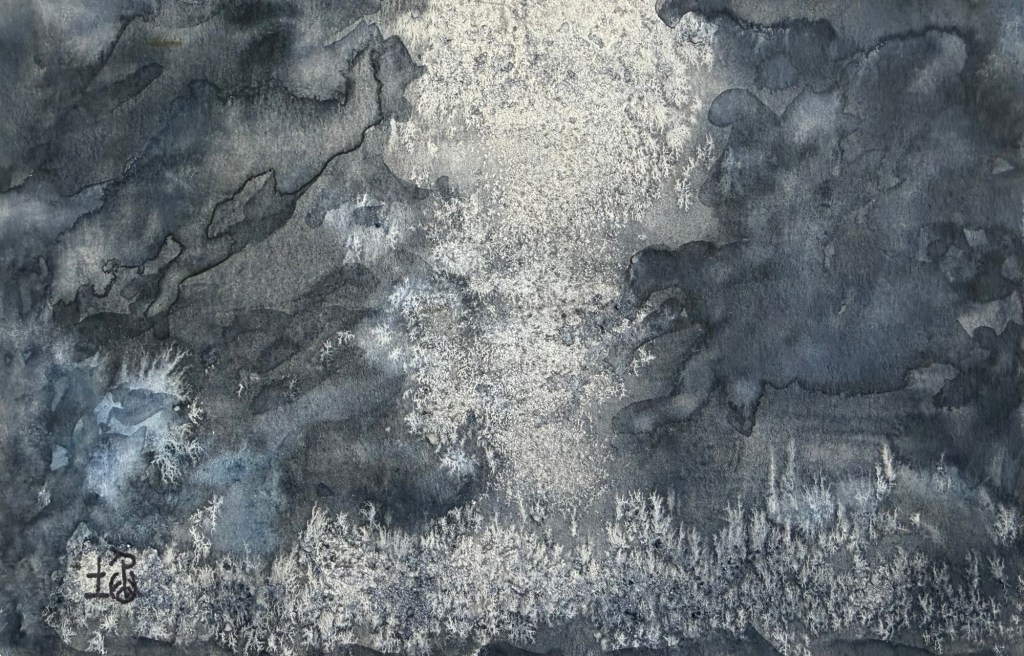
The Decision in various translations:
Huang:
Doubled darkness.
Be sincere and truthful.
Rely on heart and mind.
Prosperous and smooth,
Deeds will be honored.
Hinton: In the abiding abyss, possessing the dedication of a bird sitting on eggs: this is how heart-mind penetrates everywhere. Then, whatever you do, it will be revered.
Commentary on the image in various translations:
Pearson: Water piled upon water: the image of danger. You should constantly act with moral strength, practicing both teaching and service.
Hinton: Where water flowing over and over settles: that is Abiding Abyss. Using it, the noble-minded move perennially with heart-sight clarity, abiding in cultivation of their life’s work.
Hinton comments: “Known in ancient Chinese as ‘heart-mind’…consciousness is made of the same generative tissue; following the movement of returning thoughts and emotions appearing out of emptiness and returning to their root in that same emptiness…comes the realization that the root experienced there in consciousness, that empty source, is the source shared by all of the ten thousand things. And so, the source of the empirical Cosmos can paradoxically be described as ‘heart-mind.’”
The Yao Text
The Yao lines speak about small gains, simple offerings, and the example of King Wen’s imprisonment: endurance and integrity when constrained.
Personal Notes
How interesting to reconsider this hexagram, originally cast in late 2023, in 2024, as the deadly attacks against Palestinians escalated and the threat of Trump’s second presidency loomed. The warnings about the need for integrity and service take on more relevance as our times escalate danger.
The example of King Wen is pertinent in the face of genocide. When King Wen was in prison, his son came to negotiate for his release. The wicked Shang emperor not only killed the son, but had him made into meat cakes that were fed to his father. King Wen survived even such cruelty with integrity.
Hinton’s reflection on heart-mind (xīn) fascinates me. Years ago I read Immanuel Kant and rejected his transcendental idealism. (Not that I understood it–does any young college philosophy student really understand anything? Especially 19th century German writers.) I am wary of the leap to say the source of the cosmos is consciousness. But I enjoy the image of our heart-mind and the “ten thousand things”–such a beautiful description for reality–originating in the same emptiness. It resonates with my (again superficial) understanding or admiration for John Wheeler’s one-electron universe, described in one of my “old lady” poems.
Return to Index of Hexagrams

