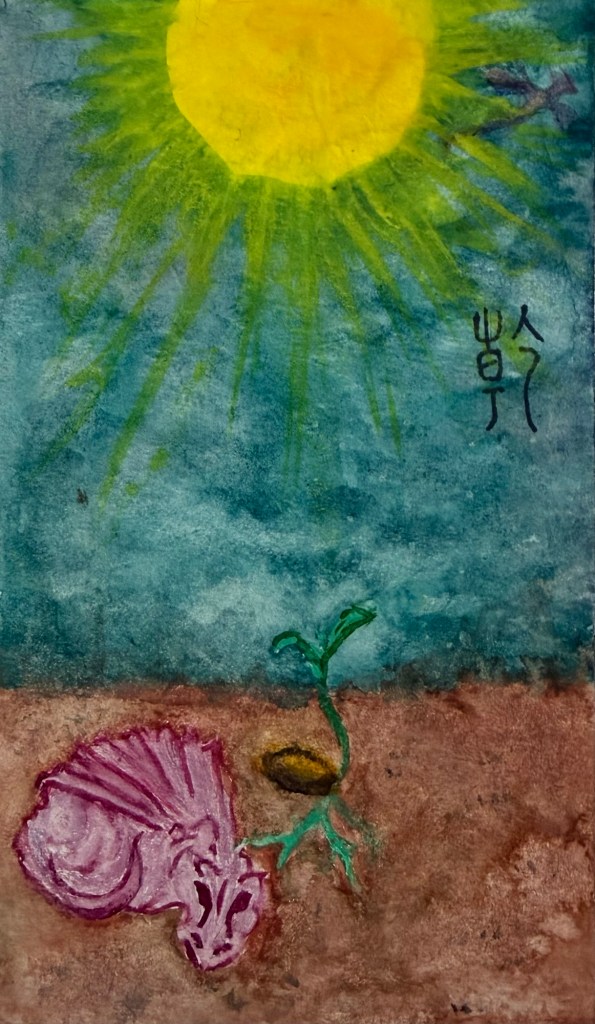
Translations of the Hexagram Title
- Wing: Creative Power
- Huang: Initiating
- Pearson: The Creative
- Hinton: Steadfast, Strong
- Legge: The Creative
- Redmond: The Creative
The decision
Huang:
Initiative:
Sublime and initiative
Prosperous and smooth
Favorable and beneficial
Steadfast and upright
Legge: “Qian — what is great and originating, penetrating, advantageous correct and firm.”
Image
Pearson: “Sky upon sky: the image of the creative. You should be like this, continually strengthening yourself.”
Legge: “Heaven in its motion, strength. The superior man, in accordance with this, nerves himself to ceaseless activity.”
Yao Lines
The Yao Lines refer to dragons. Redmond suggests, “we can see the dragon is a symbol of energy, at times latent, as in winter, at other times active, as in the summer. In this reading the texts refer to seasons, but also more generally to the energies that may be active or only potential in the situation being divined about but which need to be taken into account in deciding one’s own actions.”
Yao Line 1 translated by Legge: The dragon lies hid in the deep. It is not the time of active doing
Yao Line 5 translated by Hinton: The dragon soars in an open sky. Seek advice from a great sage and wild bounty will prevail.
Personal Reflection
Both Redmond and Huang discuss the first four words of the Book of Changes: yuan, hang, li, and zhen. Redmond suggests that the four words originally were words of invocation used when doing a divination. Huang explains that these four Chinese characters at one time described the functions of the four seasons: originating, developing, maturing, and declining. Redmond says that it was during the Spring and Autumn period that the four words took on meaning as referring to virtues. Huang describes these as the four virtues that apply to the superior person.
After struggling with so many translations of both the Book of Changes and The Analects I asked Deep Seek about the evolution and meaning of the four words. Seriously, its response is more clear and eloquent than I could manage:
The Confucian scholars mapped the seasonal/natural order onto the internal order of a virtuous person.
· 元 (Yuán – Spring/Beginning) becomes 仁 (Rén – Benevolence/Humanity): Just as spring is the benevolent beginning of all life, the virtue of benevolence is the starting point and foundation of all moral action in a person. It is the “chief good” from which all other virtues grow.
· 亨 (Hēng – Summer/Flourishing) becomes 禮 (Lǐ – Ritual Propriety): Just as summer allows things to flourish and interact harmoniously, ritual propriety allows human relationships to flourish smoothly and beautifully. It is the expression of inner virtue in the social world.
· 利 (Lì – Autumn/Harvest) becomes 義 (Yì – Righteousness): Just as autumn is the time of reaping what has been sown, righteousness is the principle of discerning what is appropriate and just, and then acting on it. It’s about reaping the moral “benefit” of correct action, which is harmony, not personal gain.
· 贞 (Zhēn – Winter/Storage) becomes 智 (Zhì – Wisdom): Just as winter is the time of firm preservation and storage for the next cycle, wisdom is the inner quality of discernment, integrity, and fidelity to moral principles. It is the firm foundation that allows a person to endure challenges and remain constant.
In my notebook I quote an author I can no longer find. The kernel of his or her observation is that by learning to keenly observe and respect the regular changes in our natural world we are better prepared to deal with the many changes that occur among people.
I find the long evolution of the first four words in the Book of Changes from an incantation to a description of nature that then is mapped onto human behavior comforting, somehow setting me down as a small pebble or seed in the long history. It is suitable for good beginnings.
Return to Index of Hexagrams
 Hook-Line-and-Thinker