18–Mountain over Wind: Gu Remedying or Gŭ Branching Out
The Decision translated by Wing: Repair can bring exceptional progress. It is advantageous to experience the collective flow. Before starting, examine the future (three days).
Image Commentary translated by Huang:
Remedying.
The firm is above and the yielding below.
Gentle and standing still.
This is remedying.
Wind blows at the foot of the mountain.
An image of decaying and repairing.
In correspondence with this,
The superior person mobilizes people
And nurtures their virtue
Of interest:
Huang and Pearson differ on the ideograph and title for this gua. Huang, like most traditional commentaries and translators, uses the jin wen “Gu” as a bowl of worms or insects for the decay to avoid or remedy. Pearson relies on the Maguandi text that archeologists found in 1972-74. She uses “Gŭ” that refers to branching, as bamboo might send up shoots. Both are pertinent to the Yao text, which deals with a child remediating the parents’ experiences and consequences.
Personal reflection:
“Gu” for a bowl of worms: Rather than being a sign of decay, worms are, in fact, the remedy for decay, as they digest the dead and rotten; they transform it into fertile earth.
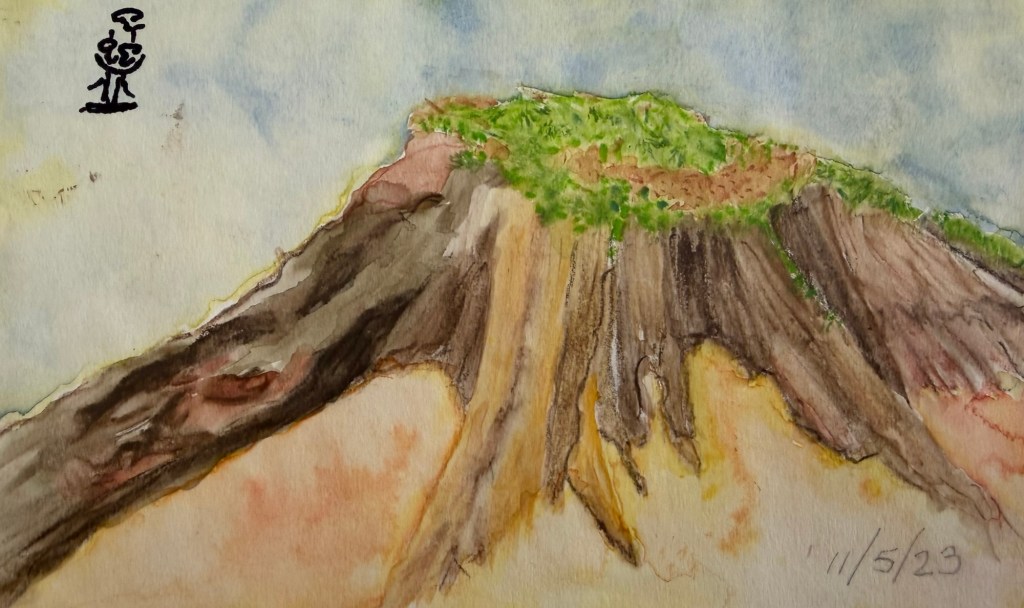
A note about context: I studied this Hexagram/Gua and did the watercolor when I was at La Pradera, a health center outside Havana in Cuba. I had gone there so sick with long COVID and a pinched nerve in my spine that my oxygen saturation would suddenly plummet and it was difficult to walk without falling. La Pradera gave me back my life. The stump covered with new growth in the watercolor is outside the building where I had treatments; how vivid and beautiful it appeared to me, the very image of repair.
And, of course, in that time thoughts about both decay and branching out were pertinent for the United States: our social decay and the bamboo-like resurgence of international resistance and solidarity.
Return to Index of Hexagrams
 Hook-Line-and-Thinker