Wars and Armistice
The United States did not win the Korean War. Instead, in 1953 the Demilitarized Zone was set up and the combatant countries began to return their dead in what was called Operation Glory. It was a time of bitter feelings. Unfortunately, patriots at Cheltenham Elementary did not sign on to the Armistice. They knocked Dani down on her way home from school in a glorious reaffirmation of American might. I remember going down with a flash of relief that I had missed the pavement and was landing on grass. I think it’s the first time I heard the words “Chinaman” and “Chink.”
And so it came to pass that Mama and Gma came up with tuition to put Dani into Emmaus Lutheran School. One 1953 dollar was the equivalent of almost $11 today, so that $10 monthly fee was a hefty sum for a waitress and secretary, perhaps a third of their income. They sacrificed to pay it as insurance, so there would be no more physical assaults.
I realize now that Emmaus was some kind of safe haven for children who might not fit in anywhere else. When I was in first and second grade, the recognized leader of the ninth grade (who might have been labeled “Head Boy” at a fancier school) had a hook for at least one of his hands; I recall him holding the door with that hook for us little kids to go out to recess. In my class there was Tommy, who had no legs. He had a gorgeous voice so always got to solo with “O Holy Night” at the Christmas pageant. He also was the champion of our baseball team. Someone else had to run bases for him, but with his powerful arms he always smashed the ball out of the field.
Sometime around our middle-school years Susi joined our class, like me, a refugee from anti-Asian hostilities, I assume. We were cheerleaders together, but not close friends, so I never asked. Because Susi was in our eighth-grade class, however, Mr. Harms taught us about the U.S. internment camps for Japanese during World War II. Not many children in the early 1960s were told that truth, but we were, even if it was not done in the best way. I remember that Susi looked stunned, could only shake her head “no” and murmur something inaudible when Mr. Harms ambushed her in class by asking which camp her parents had been sent to.
Great Moments of Classroom Management at Emmaus Lutheran
Miss Brandenberg’s discipline in our first-grade class was typical for those days. When a student was restless, inattentive, or disruptive she would send the child to stand in the corner. Once the four corners were filled, she would draw a circle on the chalkboard so the student could stand there, nose in the circle. (Dani knew well that intimate odor of chalk.) I vividly recall that day all of us were lined up at the board with our noses in circles, giggling wildly. The next day Principal Wesch taught our class, admonishing, “You naughty children have driven your teacher away.”
In third grade Mrs. Harms threw Eddie Fisher’s desk across the room when he enraged her. These days I ask myself whether that really happened. Perhaps she just telepathically told Dani what she wanted to do. Perhaps it was one of my time kinks, and Mrs. Harms was advising me for the future, after I began teaching and had moments when I knew it was best to go limp and silent before I did something to regret in the classroom. Maybe the only reason I didn’t hurl the occasional desk when teaching fourth grade a half century later was because Mrs. Harms was warning me not to do it.
For years, though, I was sure she had done so and only could not decide whether the desk flew through the air with Eddie in it or not. Did he climb out of the wreckage or stand at the launch site? Whether it did or did not happen, I know that when it was over Eddie stood there with arms crossed, smirking. He was sort of an eight-year-old James Dean acting out a child version of Rebel Without a Cause. If his father had not been a good friend of George, I probably would have liked him.
The other great moment happened during lunch in fifth grade. Every day we marched downstairs to the community room and kitchen. There was a curtained stage up front and a highly polished tile floor with a shuffleboard field in its pattern. It is not true that life was all black-and-white before the use of color film, but that room was entirely tan and gray. Every day we had a hot lunch served in partitioned trays. One day the cook decided to get fancy and serve us tomato aspic. No one liked it. Is there a ten-year-old on the planet who happily eats non-sweetened red wiggly goop? Perhaps it is the element of bait-and-switch that was so off-putting. In the 1950s we ate plenty of jello salads: green with celery and carrot shreds, yellow with cottage cheese and pineapple, red with cream cheese. But gelatinous tomato juice? Eeww.
So we all refused and scraped it into the garbage as we put our trays on the counter to be washed. The next day we again had a glob of tomato aspic on our trays, and the teacher said that no one would be dismissed from the table for recess until all of the aspic was gone. What a solidly stubborn group we were! No one ate the aspic; we sat there, missed the entire recess, and finally were marched back to class. By day three, the adults decided they could not risk losing the battle and that we would crack when faced with the prospect of sitting at the table for an hour again. But ours was the generation that would grow up to organize sit-ins, demonstrations, and civil disobedience. We were a crafty bunch. I think it was Alison Hawkins, with her perfect curls and timid demeanor, a teacher’s favorite even if her family was Presbyterian, who came up with the idea. We all drank our milk and stuffed the hated aspic into the cartons. We took our empty trays to the counter and meekly answered, “No, ma’m,” when the adult asked, “That wasn’t so bad, was it?”
Of course, discipline was not always fair. I can’t remember the name of my fifth/sixth grade teacher, but I adored him and his weekly art assignments. The week we were to paint an apple as a still life I felt inspired and worked on drafts for hours every night. I looked and drew and looked and tried again, over and over until I had the line just right. How proud I was when I turned in that assignment! How crushed when he marked it “F”, claiming I had traced it since I had painted a strong, solid outline in ink instead of using small, sketching pencil marks. I only felt vindicated decades later when I studied Chinese brush painting with Lampo Leong and learned the true meaning of line. Even now, I wish I could find that teacher’s grave and pockmark his headstone with the end of a paintbrush or pencil.
Thou. shalt. not. stunt. young. Artists!
And six decades later, after the #MeToo movement in recent years, I can finally say out loud that Mr. Harms did not handle Ronnie’s assault on Dani very well. Ronnie (if that was his name) sat behind me in our crowded classroom where one desk was right behind the other in three long rows. Ronnie began to explore my body, starting with stroking my hair and moving on to tickle my neck. If I tried to shrug away his hand or turned to hiss at him to leave me alone, I got in trouble. Once it reached the stage where Ronnie was leaning forward over his desk with his hand down my blouse pinching what had not yet budded into boobs, I could only sit frozen. Mr. Harms noticed it as he came down the aisle. “Stop that!” he thundered. But he glared at me, not Ronnie, as if it were my fault, as if all my previous attempts to evade Ronnie had been seduction. Really, I should have jumped up and heaved the desk through the window. But I just sat there ashamed.
The Birth of Gisela Marie
Aside from Ronnie, there were no more physical assaults on Dani. However, a slow and significant attempt on her soul was more successful. Emmaus was not simply Lutheran; it was Lutheran-Missouri Synod, very German Lutheran. We sang our first simplified versions of Bach chorales when we were in third grade. In fifth grade we began lessons in the German language, with textbooks written in old Germanic script. That meant I learned to love good music at an early age and developed a taste for linguistics. That was all a benefit.
However, being the only melanin-blessed child bobbing in a sea of German Lutherans was not so healthy for a young child. (Even if Alison was Presbyterian, she could pass for Lutheran with her pale skin and blue eyes.) Susi joined the class too late to save Dani as she sank into despair and self-hatred. I want to clarify: this was not deliberate soul-murder, more a case of accidental soul-manslaughter. The German Lutherans didn’t deliberately teach me to hate Dani; it was just a by-product of the situation. The sinister rumors about Chinese didn’t come from Emmaus but from Gma and Deenie, who refused to admit Dani was biracial for the sake of respectability and a fear of the tongs. They insisted I was merely Diane Mable Rupp. With a middle name like Mable and a last name like Rupp, how could I not be just like all my friends?

Can you tell which one is Dani? Karolee and the other Diane sit next to her. Alison is in the striped dress behind blond Diane. That may be Eddie of the airborne desk in front of Dani.
But one day the TV crew came. We were all so excited our school was going to be in some news feature. I wore my favorite white sweater and tried to look studious as the camera panned our classroom. Like all the Emmaus families, Gma and I tuned into the broadcast to see our moment of public glory. When our class appeared on screen it truly hit me: that dark face, contrasting so completely with the white sweater, looked nothing like her best friend Karolee Hinck or the other, blond Diane Kelso. The television might just as well have exploded with glass flying everywhere. It shattered my self-image. I was shocked and hid under the dining room table crying.
That night, under the table, Gisela Marie was born. I was clearly an imposter as Diane, and no one but Paul and Paula really knew Dani. I wanted to be Gisela Marie. Of course, in those days you were stuck with whatever your parents chose to put on a certificate. But at least I knew the truth for myself: I was Gisela Marie. I was determined to have my outer shell conform to this inner self. At school I became as demur as Alison, as dutiful as the biblical Samuel. Many nights I sat in the bathtub scrubbing, sometimes with lemon juice, more often with borax soap, trying to lighten my skin.
Terrorist Attacks: Night Stalkers and Zombies
I was raised with an Old-Testament world view, filtered through the sixteenth-century teachings of Martin Luther. This was the God who ordered Abraham to send his son Ismael to die in the desert and tie Isaac to an altar for slaughter, who turned a woman into a salt lick when she mourned the destruction around her, who tried drowning the entire world in water at least once and various tribes in blood repeatedly.
Luther was even worse. I had to memorize Luther’s Small Catechism in its entirety for confirmation. “Original sin is the total corruption of our whole human nature…. Man by nature is without true fear, love, and trust in God. He is without righteousness, is inclined only to evil, and is spiritually blind, dead, and an enemy of God.” When I studied Luther’s works in college I read a passage in which he described waking at night and seeing the eyes of God on him, burning with anger.
Here’s Giesela Marie’s confrontation with Original Sin: In the mornings I liked to stand at the edge of the grate that covered the floor heater in the kitchen. Hot air would fill my nightgown and I would look down on the flames dancing in the burner below. This led naturally to thoughts of hell and eternity. The crucial problem was that no matter how hard or how long the effort, I could not imagine eternal hell. This meant I could not believe in an infinite God. And that meant I was doomed to eternal flames. I went round and round with this many mornings.
That was my world.
So at night Dani did not sleep. I had a wonderful clock radio at the head of the bed. It allowed me to twist a knob so it would play for an hour and then turn off automatically. I’d adjust the sound as low as possible so Gma wouldn’t be disturbed and listen to the murmur of a talk show, hoping to fall asleep before the timer decreed silence. I slept next to Gma and often lay there worried about Luke 17:34. “I tell you, on that night there will be two in one bed. One will be taken and the other left.” Which would be worse, I puzzled, Gma dying or me? If I got up and slept on the couch, would it be safer? How fussy was the Angel of Death about her nightly quota?
The worst terror attack came one Wednesday before Christmas when I was in second grade. That day was special since the big holiday carnival was planned, with all sorts of candies and toys, many home-made, on sale for pennies and nickels. All we had to do was finish the weekly chapel, and then we’d start the fun. That’s when Pastor Wangerin chose to preach on 1 Corinthians 15:52. “In a moment, in the twinkling of an eye, at the last trumpet. For the trumpet will sound, and the dead will be raised incorruptible, and we shall be changed.” Pastor began with empathy for our excitement about the carnival, “In just a few minutes we get to start the celebration we’ve all looked forward to….” but then went on to crush our hopes, declaring that the last trumpet might sound any moment now; instead of the carnival we would all suddenly be changed to face the last judgment and end of days. Pastor was a reincarnated Jonathan Edwards preaching about sinners in the hands of an angry god to a terrified seven-year-old. The dead rising incorruptible sure sounded like zombies to me. Mouth gaping, I watched as the evergreen garlands that decorated the church were yanked from the pews, caught in the whirlwind taking shape in the church’s nave. Next, the pots of red poinsettias clattered as they rose from the altar, and finally all those lovingly made cookies were smashed by the force of the gale.
Homiletic Footnote:In Luke’s story, Cleopas and his friend are hiking from Jerusalem to the town of Emmaus, puzzling over the recent trial and crucifixion of their prophet and the women’s rumors of his resurrection, when Jesus joins them and adds his take on the events. When they reach the motel, Jesus starts to walk on, but the men say, “Stay with us, for it is nearly evening, and the day is almost over.” He does stay and, over supper, reveals his true identity to the men before vanishing. “Were not our hearts burning within us while he talked with us on the road and opened the Scriptures to us?” the men marvel.
This story became the basis for a famous hymn written in 1846 by Henry Francis Lye, “Abide with me; fast falls the eventide.”
Abide with me: fast falls the eventide; the darkness deepens; Lord, with me abide.When other helpers fail and comforts flee, Help of the helpless, O abide with me.
Swift to its close ebbs out life’s little day; earth’s joys grow dim, its glories pass away. Change and decay in all around I see. O thou who changest not, abide with me.
I knew this hymn well, sang those verses nightly as a cure for the “heebie-jeebies”, as Gma labeled my insomnia and anxieties. At least she had the sense to have me sing this instead of that frightful “Now I lay me down to sleep” prayer most families used. It is abusive, at the end of day, to have children recite, “If I should die before I wake, I pray the Lord my soul to take.” Doesn’t that just reek of plague and gruel?
However, I don’t think comfort is really the point of the Emmaus story. After the men ask Jesus to stay he just has a bite, introduces his real self, and disappears; he doesn’t stay around to comfort them or heal their fear of death. I think the lesson instead is that the men earn the right to know the truth by offering hospitality to the stranger. Right action, not debate and rumination, leads to understanding.
Further Kindnesses at Emmaus
Sometime during fourth grade Billy Hutchison’s mom stepped in and became our substitute teacher. I recall standing at her desk during recess once when I was overwhelmed by anxieties and exhaustion, confiding in her about my heebie-jeebies. I don’t remember her advice exactly, only sense it was a calming mantra about the loving kindness of God that I could use when frightened. Mostly, I recall how she radiated comfort and light. If we had been Papists, I would have thought she was a visitation from The Holy Mother.
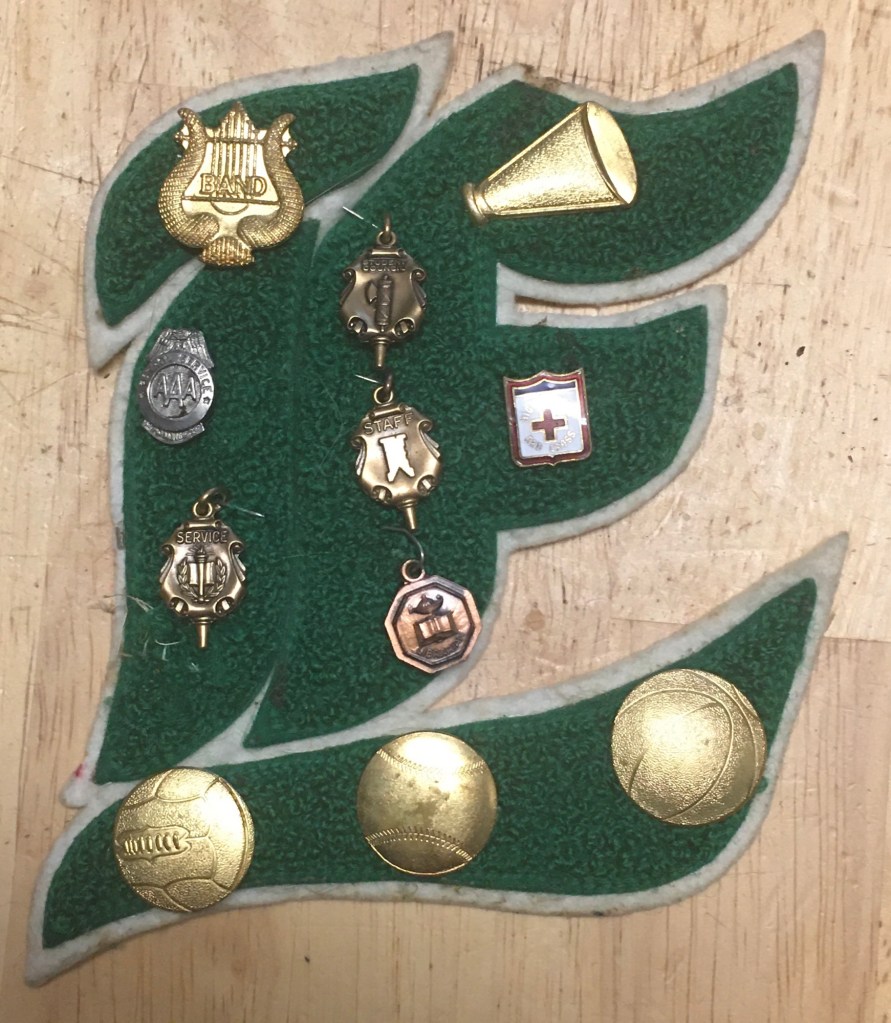
After the Sickness described later, the teachers spoke to my Gma and had me enrolled in every sport and school activity offered. When there was no after-school team practice or club I went to the church office and worked with Johnny Foust’s father, who was church secretary. He gave me odd jobs and let me operate the heavy stamping machine that used plates to ka-chung addresses onto the weekly church mailings. The image of Grandpa Bill comes to mind whenever I try to picture Mr. Foust; he was the same sort of reassuring presence.
When I recall Mrs. Hutchison and Mr. Foust, the blessing from Numbers 6 springs to mind:
“The LORD bless thee, and keep thee: The LORD make his face shine upon thee, and be gracious unto thee: The LORD lift up his countenance upon thee, and give thee peace.”
I hope that was true for their lives.
Ah! –Perhaps that ls that is what Mrs. Hutchison told me to recite when I was scared.
Speculative Footnote: Could Mrs. Hutchinson and Mr. Foust have been members of the anthropology team? They seemed infused with the values of Wodeguo, far wiser than most Missouri Synod Lutherans in mid-century America.
Continue to Thanksgiving and Maldiction
Return to Song of Samuel index
 Hook-Line-and-Thinker